
Repair your Brother PE150/180/190 embroidery machine and keep it in tip-top condition!
Saturday, 18 January 2020
Spare parts...
All now sold!
Evening all!
I have five machines in various states of disassembly that I need to get rid of. The machines are complete apart from main power boards and motors. If you need any spares (gears, sensors, shafts, hooks, plastic parts (including outer casings), and any mechanical assemblies), drop me a comment on here (your comment won't be published but I will see it).
Please include your email address in your comment so that I can reply direct (rather than through public postings on here).
If we can do a deal I'll put the parts you want on ebay and you can buy them with confidence.
Thanks
Dave


Tuesday, 17 November 2015
Hairbows...
This is just a quick advert for my partner's site. She makes the most delightful hairbows. Her online shop is full of them:

Direct link: dreambows.co.uk
D.
Direct link: dreambows.co.uk
D.
Tuesday, 22 October 2013
That's all, folks...
Well, it was fun while it lasted but a change in direction means that we are no longer making and selling motifs. Rather, our hair bow project has really taken off and all our time is spent supporting that. That also means that our collection of PE150s, etc, has been retired. I haven't quite decided what to do with them yet, or the collection of spare parts that I've built up over the years. But what this does all mean is that I've no more posts about the machines for this blog which I now intend to close. When I say 'close', I'll leave it in place for reference purposes - it still gets plenty of hits each month and I hope people find it helpful. I'll also be on hand to answer any PE150 related questions which come up (as they do from time to time), but otherwise, this is probably my last post on here. Since I do enjoy the occasional blog post, however, I'll be opening a brand new site which covers the various fixes and repairs I do to my other stuff. I've also given up smoking and started vaping and the mod bug has already started to bite. If I do anything worthwhile in that regard I'll be sure to post it on the new blog which can be found here:

So, take it easy and enjoy your embroidering.
Cheers
Dave
So, take it easy and enjoy your embroidering.
Cheers
Dave
Thursday, 7 March 2013
Don't worry....
... about the new footers on each post. I was told that plenty of links to my external sites would help them in Google's search rankings. Accordingly....
More soon, no doubt... D
More soon, no doubt... D
Wednesday, 6 February 2013
A bit of crazy on the side...
I suppose the point must eventually come where one takes a step back from one's spare parts pile and wonders whether it will ever actually get used! I'm not quite at that stage yet but a like-minded friend of mine has hit upon a way of making space and creating something that is interesting and fun at the same time. You'll see what I mean from the pictures below :)


More soon, no doubt...
D
Monday, 7 January 2013
PE150 Main Power Board Fix (in theory, at least...)
Since I've recently been asked about the fix that I've been promising for the last 18 months, I thought I'd share the theory. I have repaired one of my broken boards using the parts I've obtained however I've not tested it with a motor yet. For information, the repair requires the replacement of the:


- optocoupler - TLP750
- mosfet - FS3UM-9
- transistor - 2SC1740


More soon, no doubt.
D
Saturday, 1 December 2012

Wednesday, 21 November 2012
Motors...
In the Main board, power board and motor removal tutorial, you get to see the main motor used in the Brother PE150. This motor drives the needle mechanism and the spinning outer hook in the base of the machine. There are, however, two more motors in this machine. These two motors control the X/Y movement of the frame holder. These pictures, which are of one of the machines in my spares pile, show the size and location of the X and Y motors, and the gearing they are attached to:


For the record, I've never had one of these motors fail. I expect that's because, all things considered, they don't actually do a great deal.
More soon, no doubt....
D


For the record, I've never had one of these motors fail. I expect that's because, all things considered, they don't actually do a great deal.
More soon, no doubt....
D
Tuesday, 20 November 2012

Monday, 29 October 2012
Shameless advert....
... for our business. Feel free to have a browse around and even if you don't want to buy something it might give you some inspiration for your own projects!

More soon, no doubt....
D
Monday, 22 October 2012
Any requests?
Even though at the moment there are hardly enough hours in the day, I've decided to invite some topic or project requests. After all, the nights are now drawing-in and my work on rebranding our estore is nearly complete. I therefore expect to have some spare time on my hands. So, if you are contemplating making some changes to your machine, investigating a fault or fixing a new part, and you'd like to see a tutorial about it on this site, feel free to drop me a line and I'll see what I can do. I've stripped these machines back to the bare case, and fully re-assembled, so no subject is beyond this site. Or you might just want me to complete the tutorial on how I deep clean my machines!
More soon, no doubt....
D
More soon, no doubt....
D
Monday, 1 October 2012
A bit more on timing....
If you are having regular problems with timing slips and you're not trying to embroider heavy fabric or experiencing some other issue such as with thread tension, then it is possible that the bevel gear on the main shaft is loose. Specifically, the grubs screws in the gear have slackened off and any resistance in hook area causes an easy slip. It will be easier to explain with a few pictures.
You need to remove the outer casing to access the gear which can be seen just under the handle in this picture:

Here is a close up of the bevel gear and one of the grub screws (which takes a 3mm allen key)


So, if you are having repeated problems with timing slips you should investigate the bevel gear. To do that you need to follow steps 1 to 9 of the Take it apart tutorial. Then, using your allen key, back off the two grub screws in the gear and then reposition the gear against the corresponding plastic gear underneath. Turning the handwheel slightly ensures that everything goes into place snuggly! Retighten the grub screws and then follow the Check and adjust the timing tutorial. All being well, you'll be able to time the machine! Once you are happy with the timing, refit all the plastic trim and embroider a test pattern to check correct operation.
More soon (including an update on my power board fix which I'm sure now works but I need to buy another motor for testing purposes!)
D.
You need to remove the outer casing to access the gear which can be seen just under the handle in this picture:

Here is a close up of the bevel gear and one of the grub screws (which takes a 3mm allen key)

And from a different angle:

So, if you are having repeated problems with timing slips you should investigate the bevel gear. To do that you need to follow steps 1 to 9 of the Take it apart tutorial. Then, using your allen key, back off the two grub screws in the gear and then reposition the gear against the corresponding plastic gear underneath. Turning the handwheel slightly ensures that everything goes into place snuggly! Retighten the grub screws and then follow the Check and adjust the timing tutorial. All being well, you'll be able to time the machine! Once you are happy with the timing, refit all the plastic trim and embroider a test pattern to check correct operation.
More soon (including an update on my power board fix which I'm sure now works but I need to buy another motor for testing purposes!)
D.
Thursday, 19 July 2012
New PE150 fix coming very soon (I promise)...
About a year ago I promised a new fix for broken power boards. You may remember my lament that boards had a habit of blowing whenever the main motor failed and that new boards were expensive. Well, after a load of research and a bit of self-learning about electronics, I've concluded that the power board has a design fault inasmuch as there is no overload protection on the circuit which powers the motor. Perhaps one day I'll be able to design some protection into the circuit but until then, I will be repairing broken boards. I can do this because I've obtained a small supply of the long-obsolete components which comprise the circuit which powers the motor. I'll provide more details once the parts have arrived and I've completed and then soak-tested the first repair.
More soon, no doubt!
D
More soon, no doubt!
D
Saturday, 9 June 2012
Sky Netgear DG834GT - a bit more on the side...
Well, it's been busy, busy, busy what with the new addition to the family. And in my spare time I've been fixing a few things. The other week it was a Samsung 19" LCD TV rescued from a skip (thrown there, presumably, because it was completely dead). I changed all the capacitors on the main power board and hey presto: a working LCD TV for my kitchen :). Tonight, I have been mostly fixing my mum's Netgear broadband router. The router was powering on but behaving very oddly with intermittent wireless/wired functionality and no ADSL connection whatsoever. I flicked the router open and immediately noted that four capacitors were bulging (three 6.3v 470uf and the 16v 220uf one). I didn't have any of these spare but I did have an old PC motherboard with a bunch of what I needed on. So, to cut a long story short I removed the faulty caps from the router's main board and replaced them with ones desoldered from the old PC motherboard. Result: router now working fine. A subsequent Google search suggests that blown caps in this router is not an uncommon problem.
This is part-way through the repair and the caps I've changed are highlighted. The replacement 470uf caps I've used are 16v rather than 6.3v (beggars can't be choosers) so its a bit of a tight squeeze. Interestingly, the caps that have blown are all one particular make. There are other caps on the board made by a different company and these are all in good order.


More soon, no doubt!
This is part-way through the repair and the caps I've changed are highlighted. The replacement 470uf caps I've used are 16v rather than 6.3v (beggars can't be choosers) so its a bit of a tight squeeze. Interestingly, the caps that have blown are all one particular make. There are other caps on the board made by a different company and these are all in good order.

You can see how the still-to-be-changed 220uf cap in this picture (second one in from the left) has blown...

More soon, no doubt!
Thursday, 3 May 2012
Some new blog stuff
Google have very kindly provided some extra blog features and I've included two of them in the left-hand column (over there <<<<<<<<<<< ).
The first is a 'poll' feature. As the stats for this site show that there have been nearly 1000 unique visitors, most of whom arrived at the tutorial on checking and adjusting the timing and my lament on the all too common error message "check if thread is entangled, check if needle is bent", I thought it would be interesting to see whether people were finding the information helpful. I'd therefore be grateful if you could answer the question and let me know!
The second is Google's "Translate" feature. I've included this because the stats for this site show that there are visitors from right around the world including such places as Afghanistan and Venezuela! I don't know how good the translate feature actually is, or whether the subtle irony in some of my posts comes across, but some may find it useful so there you go.
More soon, no doubt....
The first is a 'poll' feature. As the stats for this site show that there have been nearly 1000 unique visitors, most of whom arrived at the tutorial on checking and adjusting the timing and my lament on the all too common error message "check if thread is entangled, check if needle is bent", I thought it would be interesting to see whether people were finding the information helpful. I'd therefore be grateful if you could answer the question and let me know!
The second is Google's "Translate" feature. I've included this because the stats for this site show that there are visitors from right around the world including such places as Afghanistan and Venezuela! I don't know how good the translate feature actually is, or whether the subtle irony in some of my posts comes across, but some may find it useful so there you go.
More soon, no doubt....
Sunday, 4 March 2012
Wanted: Dead or Alive
I want to buy your machine!
I also want your working machine. If you have a machine that's just sat in the cupboard gathering dust or if you have recently upgraded, why not sell me your old PE100, PE150, PE180, PE190? Any condition considered. Cash/PayPal.Just drop me an email or reply to this post with some details!
Saturday, 25 February 2012
Any spare motors about?
Called BSK today for yet another PE150 main motor and noooooo..... they are out of stock! Not only that - so are Brother! There's nothing available until May 2012. So, does anyone have a spare working motor I could buy? Or even an old machine that I could buy for spares?
On the plus side, if Brother have none but are getting some in, that presumably means that they are having them made (motor and PCB). Will be interesting to see precisely which motor is being used and whether there have been any other revisions.
More soon, no doubt....
Update
As luck would have it, BSK gave me a call on 1st March to advise that they now have some motors in stock. Needless to say, I bought one! The part number on the chitty is XA0468001.
On the plus side, if Brother have none but are getting some in, that presumably means that they are having them made (motor and PCB). Will be interesting to see precisely which motor is being used and whether there have been any other revisions.
More soon, no doubt....
Update
As luck would have it, BSK gave me a call on 1st March to advise that they now have some motors in stock. Needless to say, I bought one! The part number on the chitty is XA0468001.
Monday, 7 November 2011
A little bit on the side....
Not had much time lately to spend on my project machine or this blog.
And then on Sunday night, the first reasonably chilly night of the year, my boiler packed up.
In fact, to be more precise, there was no spark at the electrodes over the gas burner and so the damn thing would not light. Now, being the inquisitive sort, I couldn't help having a poke around. I quickly identified that tapping underneath the tray containing the PCBs whilst the boiler was going through its lighting cycle resulted in a spark and flame and a lit boiler. On the other hand, this was the only way to get the boiler to light, whether for hot water or heating. Needless to say, the house was freezing cold this morning when I woke up.
On inspection through the window into the combustion chamber, the electrodes do look like they're past their best: the gap between them is, according to the manufacturer, supposed to be 4mm. The ends of the electrodes look burnt away and the gap looks at least 6mm so I've ordered a new pair today.

That doesn't explain why the boiler wasn't even trying to light, however. So, bearing in mind my technique for getting it to light (see above), I decided there might be a fault on the ignition PCB.
A bit of googling later and it turns out that this particular PCB is known to have problems. The PCB is made by Honeywell (GC E83-142) and is used in a number of boilers made by different manufacturers (for example Ideal (part no. 172548) or Biasi (part no. BI1305101), same part but different price!). Perhaps more interestingly was the number of firms offering 'repaired' PCBs on an exchange basis for about half the price of a new board.
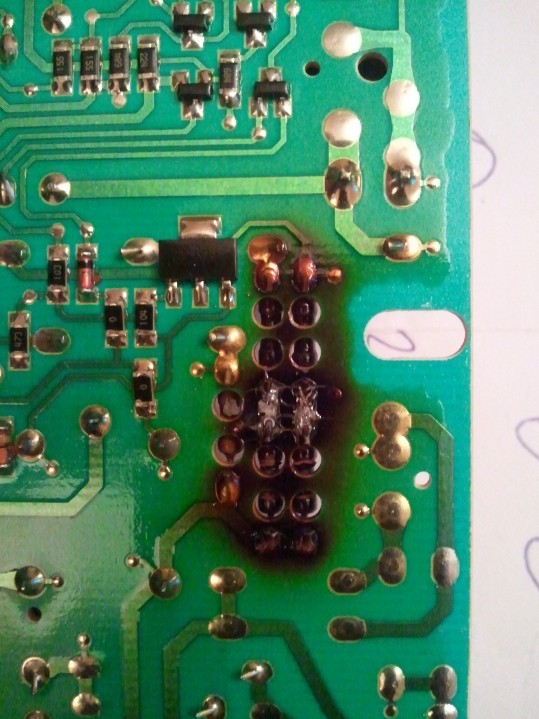
Tonight I removed the PCB. The photos below show heat damage on the board around the 16KO and 10KO resistors. In fact, the heat seems to have dissolved the original solder away and the resistors were 'rocking' on the board. This probably explains why the boiler did start when I gave the underside of the PCB tray a knock - it was enough to shake those poor resistors into action!


So, I popped out my trusty soldering iron and after cleaning off the old, burnt varnish, applied some fresh solder at the relevant points. A quick visual check over the rest of the PCB didn't reveal any other obvious problems so I refitted the board and switched the boiler on. That was a couple of hours ago and the boiler has been fine since. Toasty.
Tomorrow I think I'll get some replacement resistors and do a proper repair job. This will complement the new electrodes (the Ideal part numbers for which are, incidentally, 172532 and 172533 (GC E83-126 and E83-127)).
More soon, no doubt...
And then on Sunday night, the first reasonably chilly night of the year, my boiler packed up.
In fact, to be more precise, there was no spark at the electrodes over the gas burner and so the damn thing would not light. Now, being the inquisitive sort, I couldn't help having a poke around. I quickly identified that tapping underneath the tray containing the PCBs whilst the boiler was going through its lighting cycle resulted in a spark and flame and a lit boiler. On the other hand, this was the only way to get the boiler to light, whether for hot water or heating. Needless to say, the house was freezing cold this morning when I woke up.
On inspection through the window into the combustion chamber, the electrodes do look like they're past their best: the gap between them is, according to the manufacturer, supposed to be 4mm. The ends of the electrodes look burnt away and the gap looks at least 6mm so I've ordered a new pair today.

That doesn't explain why the boiler wasn't even trying to light, however. So, bearing in mind my technique for getting it to light (see above), I decided there might be a fault on the ignition PCB.
A bit of googling later and it turns out that this particular PCB is known to have problems. The PCB is made by Honeywell (GC E83-142) and is used in a number of boilers made by different manufacturers (for example Ideal (part no. 172548) or Biasi (part no. BI1305101), same part but different price!). Perhaps more interestingly was the number of firms offering 'repaired' PCBs on an exchange basis for about half the price of a new board.
Tonight I removed the PCB. The photos below show heat damage on the board around the 16KO and 10KO resistors. In fact, the heat seems to have dissolved the original solder away and the resistors were 'rocking' on the board. This probably explains why the boiler did start when I gave the underside of the PCB tray a knock - it was enough to shake those poor resistors into action!



So, I popped out my trusty soldering iron and after cleaning off the old, burnt varnish, applied some fresh solder at the relevant points. A quick visual check over the rest of the PCB didn't reveal any other obvious problems so I refitted the board and switched the boiler on. That was a couple of hours ago and the boiler has been fine since. Toasty.
Tomorrow I think I'll get some replacement resistors and do a proper repair job. This will complement the new electrodes (the Ideal part numbers for which are, incidentally, 172532 and 172533 (GC E83-126 and E83-127)).
More soon, no doubt...
Subscribe to:
Posts (Atom)