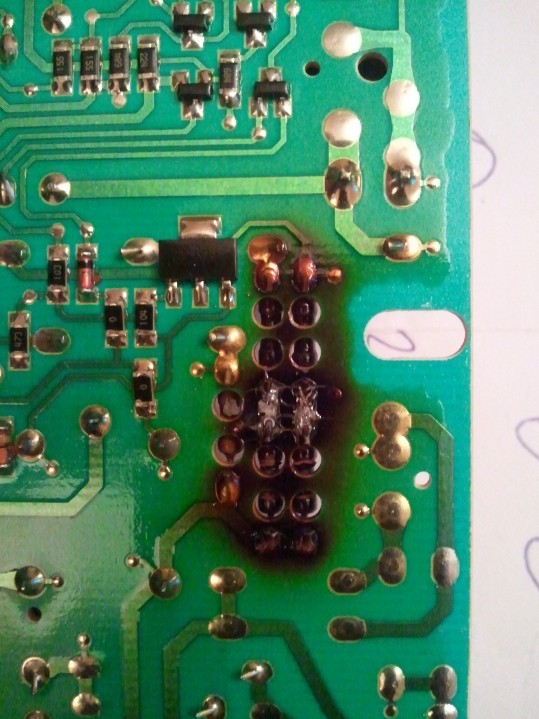
About a year ago I promised a new fix for broken power boards. You may remember my lament that boards had a habit of blowing whenever the main motor failed and that new boards were expensive. Well, after a load of research and a bit of self-learning about electronics, I've concluded that the power board has a design fault inasmuch as there is no overload protection on the circuit which powers the motor. Perhaps one day I'll be able to design some protection into the circuit but until then, I will be repairing broken boards. I can do this because I've obtained a small supply of the long-obsolete components which comprise the circuit which powers the motor. I'll provide more details once the parts have arrived and I've completed and then soak-tested the first repair.
More soon, no doubt!
D
Thursday, 19 July 2012
Saturday, 9 June 2012
Sky Netgear DG834GT - a bit more on the side...
Well, it's been busy, busy, busy what with the new addition to the family. And in my spare time I've been fixing a few things. The other week it was a Samsung 19" LCD TV rescued from a skip (thrown there, presumably, because it was completely dead). I changed all the capacitors on the main power board and hey presto: a working LCD TV for my kitchen :). Tonight, I have been mostly fixing my mum's Netgear broadband router. The router was powering on but behaving very oddly with intermittent wireless/wired functionality and no ADSL connection whatsoever. I flicked the router open and immediately noted that four capacitors were bulging (three 6.3v 470uf and the 16v 220uf one). I didn't have any of these spare but I did have an old PC motherboard with a bunch of what I needed on. So, to cut a long story short I removed the faulty caps from the router's main board and replaced them with ones desoldered from the old PC motherboard. Result: router now working fine. A subsequent Google search suggests that blown caps in this router is not an uncommon problem.
This is part-way through the repair and the caps I've changed are highlighted. The replacement 470uf caps I've used are 16v rather than 6.3v (beggars can't be choosers) so its a bit of a tight squeeze. Interestingly, the caps that have blown are all one particular make. There are other caps on the board made by a different company and these are all in good order.
More soon, no doubt!
This is part-way through the repair and the caps I've changed are highlighted. The replacement 470uf caps I've used are 16v rather than 6.3v (beggars can't be choosers) so its a bit of a tight squeeze. Interestingly, the caps that have blown are all one particular make. There are other caps on the board made by a different company and these are all in good order.
You can see how the still-to-be-changed 220uf cap in this picture (second one in from the left) has blown...
More soon, no doubt!
Labels:
Sky Netgear DG834GT
Thursday, 3 May 2012
Some new blog stuff
Google have very kindly provided some extra blog features and I've included two of them in the left-hand column (over there <<<<<<<<<<< ).
The first is a 'poll' feature. As the stats for this site show that there have been nearly 1000 unique visitors, most of whom arrived at the tutorial on checking and adjusting the timing and my lament on the all too common error message "check if thread is entangled, check if needle is bent", I thought it would be interesting to see whether people were finding the information helpful. I'd therefore be grateful if you could answer the question and let me know!
The second is Google's "Translate" feature. I've included this because the stats for this site show that there are visitors from right around the world including such places as Afghanistan and Venezuela! I don't know how good the translate feature actually is, or whether the subtle irony in some of my posts comes across, but some may find it useful so there you go.
More soon, no doubt....
The first is a 'poll' feature. As the stats for this site show that there have been nearly 1000 unique visitors, most of whom arrived at the tutorial on checking and adjusting the timing and my lament on the all too common error message "check if thread is entangled, check if needle is bent", I thought it would be interesting to see whether people were finding the information helpful. I'd therefore be grateful if you could answer the question and let me know!
The second is Google's "Translate" feature. I've included this because the stats for this site show that there are visitors from right around the world including such places as Afghanistan and Venezuela! I don't know how good the translate feature actually is, or whether the subtle irony in some of my posts comes across, but some may find it useful so there you go.
More soon, no doubt....
Labels:
blog features
Sunday, 4 March 2012
Wanted: Dead or Alive
I want to buy your machine!
If you don't fancy repairing your broken machine and don't want to pay someone to do it for you, why not sell it to me (UK only)? I want your broken PE100, PE150, PE180, PE190. Any condition considered.
Just drop me an email or reply to this post with some details!
Labels:
buy PE-150,
sell PE-150
Saturday, 25 February 2012
Any spare motors about?
Called BSK today for yet another PE150 main motor and noooooo..... they are out of stock! Not only that - so are Brother! There's nothing available until May 2012. So, does anyone have a spare working motor I could buy? Or even an old machine that I could buy for spares?
On the plus side, if Brother have none but are getting some in, that presumably means that they are having them made (motor and PCB). Will be interesting to see precisely which motor is being used and whether there have been any other revisions.
More soon, no doubt....
Update
As luck would have it, BSK gave me a call on 1st March to advise that they now have some motors in stock. Needless to say, I bought one! The part number on the chitty is XA0468001.
On the plus side, if Brother have none but are getting some in, that presumably means that they are having them made (motor and PCB). Will be interesting to see precisely which motor is being used and whether there have been any other revisions.
More soon, no doubt....
Update
As luck would have it, BSK gave me a call on 1st March to advise that they now have some motors in stock. Needless to say, I bought one! The part number on the chitty is XA0468001.
Labels:
Brother PE-150 repair,
motor,
X81048152
Monday, 7 November 2011
A little bit on the side....
Not had much time lately to spend on my project machine or this blog.
And then on Sunday night, the first reasonably chilly night of the year, my boiler packed up.
In fact, to be more precise, there was no spark at the electrodes over the gas burner and so the damn thing would not light. Now, being the inquisitive sort, I couldn't help having a poke around. I quickly identified that tapping underneath the tray containing the PCBs whilst the boiler was going through its lighting cycle resulted in a spark and flame and a lit boiler. On the other hand, this was the only way to get the boiler to light, whether for hot water or heating. Needless to say, the house was freezing cold this morning when I woke up.
On inspection through the window into the combustion chamber, the electrodes do look like they're past their best: the gap between them is, according to the manufacturer, supposed to be 4mm. The ends of the electrodes look burnt away and the gap looks at least 6mm so I've ordered a new pair today.
That doesn't explain why the boiler wasn't even trying to light, however. So, bearing in mind my technique for getting it to light (see above), I decided there might be a fault on the ignition PCB.
A bit of googling later and it turns out that this particular PCB is known to have problems. The PCB is made by Honeywell (GC E83-142) and is used in a number of boilers made by different manufacturers (for example Ideal (part no. 172548) or Biasi (part no. BI1305101), same part but different price!). Perhaps more interestingly was the number of firms offering 'repaired' PCBs on an exchange basis for about half the price of a new board.
Tonight I removed the PCB. The photos below show heat damage on the board around the 16KO and 10KO resistors. In fact, the heat seems to have dissolved the original solder away and the resistors were 'rocking' on the board. This probably explains why the boiler did start when I gave the underside of the PCB tray a knock - it was enough to shake those poor resistors into action!
So, I popped out my trusty soldering iron and after cleaning off the old, burnt varnish, applied some fresh solder at the relevant points. A quick visual check over the rest of the PCB didn't reveal any other obvious problems so I refitted the board and switched the boiler on. That was a couple of hours ago and the boiler has been fine since. Toasty.
Tomorrow I think I'll get some replacement resistors and do a proper repair job. This will complement the new electrodes (the Ideal part numbers for which are, incidentally, 172532 and 172533 (GC E83-126 and E83-127)).
More soon, no doubt...
And then on Sunday night, the first reasonably chilly night of the year, my boiler packed up.
In fact, to be more precise, there was no spark at the electrodes over the gas burner and so the damn thing would not light. Now, being the inquisitive sort, I couldn't help having a poke around. I quickly identified that tapping underneath the tray containing the PCBs whilst the boiler was going through its lighting cycle resulted in a spark and flame and a lit boiler. On the other hand, this was the only way to get the boiler to light, whether for hot water or heating. Needless to say, the house was freezing cold this morning when I woke up.
On inspection through the window into the combustion chamber, the electrodes do look like they're past their best: the gap between them is, according to the manufacturer, supposed to be 4mm. The ends of the electrodes look burnt away and the gap looks at least 6mm so I've ordered a new pair today.
That doesn't explain why the boiler wasn't even trying to light, however. So, bearing in mind my technique for getting it to light (see above), I decided there might be a fault on the ignition PCB.
A bit of googling later and it turns out that this particular PCB is known to have problems. The PCB is made by Honeywell (GC E83-142) and is used in a number of boilers made by different manufacturers (for example Ideal (part no. 172548) or Biasi (part no. BI1305101), same part but different price!). Perhaps more interestingly was the number of firms offering 'repaired' PCBs on an exchange basis for about half the price of a new board.
Tonight I removed the PCB. The photos below show heat damage on the board around the 16KO and 10KO resistors. In fact, the heat seems to have dissolved the original solder away and the resistors were 'rocking' on the board. This probably explains why the boiler did start when I gave the underside of the PCB tray a knock - it was enough to shake those poor resistors into action!
So, I popped out my trusty soldering iron and after cleaning off the old, burnt varnish, applied some fresh solder at the relevant points. A quick visual check over the rest of the PCB didn't reveal any other obvious problems so I refitted the board and switched the boiler on. That was a couple of hours ago and the boiler has been fine since. Toasty.
Tomorrow I think I'll get some replacement resistors and do a proper repair job. This will complement the new electrodes (the Ideal part numbers for which are, incidentally, 172532 and 172533 (GC E83-126 and E83-127)).
More soon, no doubt...
Labels:
172548,
BI1305101,
E83-142,
PCB repair
Monday, 17 October 2011
Buying spare parts...
I didn't get chance to finish the cleaning tutorial today however I have been asked about where to buy spares. I get my original Brother spares from Bedford Sewing & Knitting (click the name to open their website and note that you will need to call them with your requirements). I use BSK as they are in the UK, as am I, but in my quest for cheaper spares I've found a few places elsewhere in the world although they do not, apparently, supply to the UK.
So, for the USA, you've got UED and BOS and for Europe I found Convena. No doubt there are others but these sites have online searchable catalogues (by manufacturer part number) and price lists.
Having said all that, I'm determined to find a cheaper way to fix these machines. For example, the £60 replacement motor for the PE150 is made by Johnson Motors (minus the PCB assembly, which is serviceable for a few pence, but that's a tutorial for another day). This is the current incarnation of the motor and I expect, if it could be bought on its own, would be less than £10 but can I find a supplier who will let me buy just a couple of units? No - minimum order is 5000....
More soon, no doubt.
So, for the USA, you've got UED and BOS and for Europe I found Convena. No doubt there are others but these sites have online searchable catalogues (by manufacturer part number) and price lists.
Having said all that, I'm determined to find a cheaper way to fix these machines. For example, the £60 replacement motor for the PE150 is made by Johnson Motors (minus the PCB assembly, which is serviceable for a few pence, but that's a tutorial for another day). This is the current incarnation of the motor and I expect, if it could be bought on its own, would be less than £10 but can I find a supplier who will let me buy just a couple of units? No - minimum order is 5000....
More soon, no doubt.
Labels:
Brother PE-150 repair,
parts,
spares
Subscribe to:
Posts (Atom)